
I must thank Chaidura for appearing in my life last October (Demon`s Night nonetheless but then what else can you expect from a yōkai in human form), because since then my musical radar has been gravitating towards incredible art and projects I`d probably never discover myself. It won’t be far from the truth to write that it feels like my mind has been opened to horizons and experiences so fascinating that I sometimes think I befriended a supernatural spirit.
If Chaidura is indeed a kami of finding cultural gems, having his favour has some powerful benefits. I no longer need to actively look for good music! It finds me instead. Few months ago I received AcidSitter record to review – an obligatory listen to all fans of garage and psychedelia. About a week ago I was introduced to R:eo – a remarkable artist on the independent circuit that will be featured on our blog in the near future. Bands like Esprit D`Air, Sailor Honeymoon and Kvro just started to appear on my social media feeds on their own accord.
I know, there is a better explanation for it – the algorithm. You check out one thing and then you are being bombarded with the same ad nauseum. But I like to think there is something more happening here than AI just tracking my online presence. Especially when discovering bands like Ryūjin.
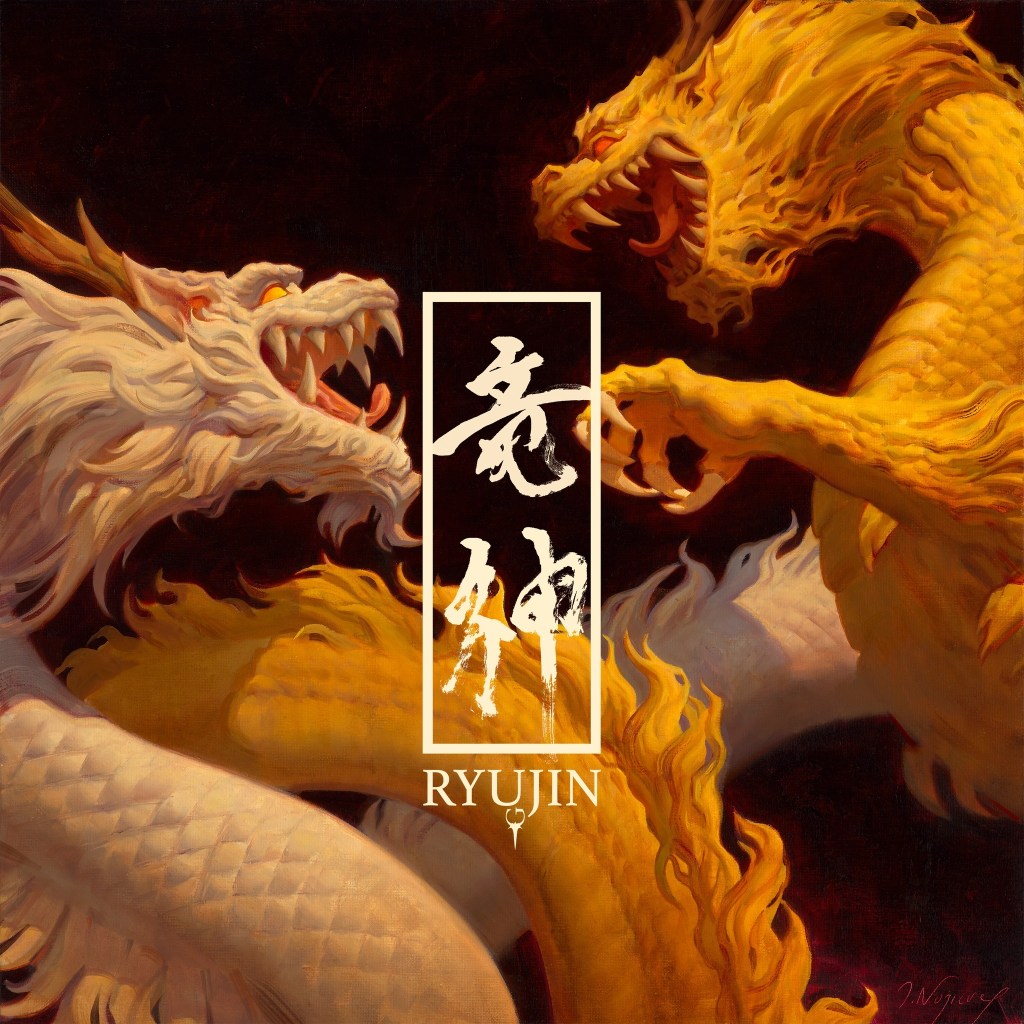
the cover of Ryujin self titled album
I wasn’t familiar with that name when a trailer to the single “Saigo no Hoshi” appeared on my screen for the first time. I however was quite fond of GYZE, a Japanese rock/symphonic metal four piece from Hokkaido, Japan. I loved their second album “Black Bride” released in 2015, mostly because they reminded me of Finnish legends Sentenced. It was quite a revelation to find out that GYZE is Ryūjin under a new name and with new members.
GYZE (previously also called Suicide Heaven) at its core has always been a project of drummer Shinomoto Shuji and guitarist/singer/band leader Shinomoto Ryoji. Kind of a Cavalera Brothers arrangement. They have been working closely with bassist Watanabe Aruta and various session musicians to compliment them on tours and recordings. In 2019, after the release of their fourth album “Asian Chaos”, the band took a break as Shuji battled undisclosed medical illness. That break wasn’t however in vain, the band regrouped, signed a contract with Napalm Records, found a manager in Matt Heafy (TRIVIUM, Ibaraki) and recorded what must be their best material yet… as Ryūjin.
Not every artist wants to change their image or go in a different creative direction. What is easy for a pop star like Madonna, is not always welcomed with open arms by metal chordes. Just ask Paradise Lost when they released “One Second” or Morgoth following “Feel Sorry for the Fanatic”. Ryūjin didn’t completely change their sound, they are still a mash of J Rock, heavy metal and symphonic elements but their metamorphosis pushed them into what they call now “samurai metal”. Japanese folklore, language, mythology and cultural elements take the front stage. Shinomoto Ryoji began to play instruments such as shamisen (three stringed hand plucked instrument similar to banjo that is essential in traditional Japanese music and theatre such as Noh) and ryūteki (bamboo flutes popularly known as dragon flute). The band members adopted kimonos, hakama and facial masks such as menpō and hannya for their stage attire.

Ryujin ready to rock – photo by Litchi
Ryūjin come at a time when metal music finds itself at the forefront of discussion about race, culture and identity. If you do not follow heavy music as closely as me then you may raise an eyebrow, but for the rest of us, it is quite evident. Obviously, metal has never been for white dudes only, but somehow the myth prevailed, especially in Europe, where everyone looked at the Helvete scene and thought they were something more than a bunch of criminals, racists, murderers and arsonists.
Diversity is metal’s greatest accomplishment and biggest names in the genre prove it: Tom Araya (Latino), Chuck Billy (Native American), Dino Cazeras (Mexican) or Joe Yamanaka (Japanese/Caribbean) laid foundations of what we know as heavy music. Second album by Japanese Flower Travellin’ Band named “Satori” was released just a few months after Black Sabbath`s debut and is universally recognized as a stepping stone in rock history.
But back to what is happening recently on the metal circuit. Heavy music is a tool of expression for musicians all over the world, but since 2010 there is a visible shift. First came Mongolian rock acts such as Tengger Cavalry, The Hu or Uuhai who put their language, traditional instruments and vocal techniques at the forefront of what they were doing. And somehow it opened the gates for others to follow. Today we can enjoy Maori bands (Shepherd`s Reign, Alien Weaponry), heavy metal from India (Bloodywood), pagan metal created by Native Americans (Blackbraid), black metal projects led by Black women (Jade the Nightmare) or resurgence of nu metal with a strong feminist overtones (Cinnamon Babe, Hanabie). There are even acts such as Voice of Baceprot (Indonesia) who combine guitar music with Islamic elements. I`m a huge fan of anything loud so seeing this change is huge news for me. I always thought and considered music to be a force through which one can learn and understand other cultures, sometimes in a way that is much better than academic setting, as lectures and lessons are not suitable for everyone.
If you want to immerse yourself in Japanese history then listening to Ryūjin and watching their videos is an absolute pleasure. At first, for the sake of this review, I wanted to focus on the entire album but that would make this article a way too long. So, I chose “Saigo no Hoshi”, but want to make some points to prove to the readers why listening to “samurai metal” is much more than epic guitar or shamisen solos and jaw breaking visuals.
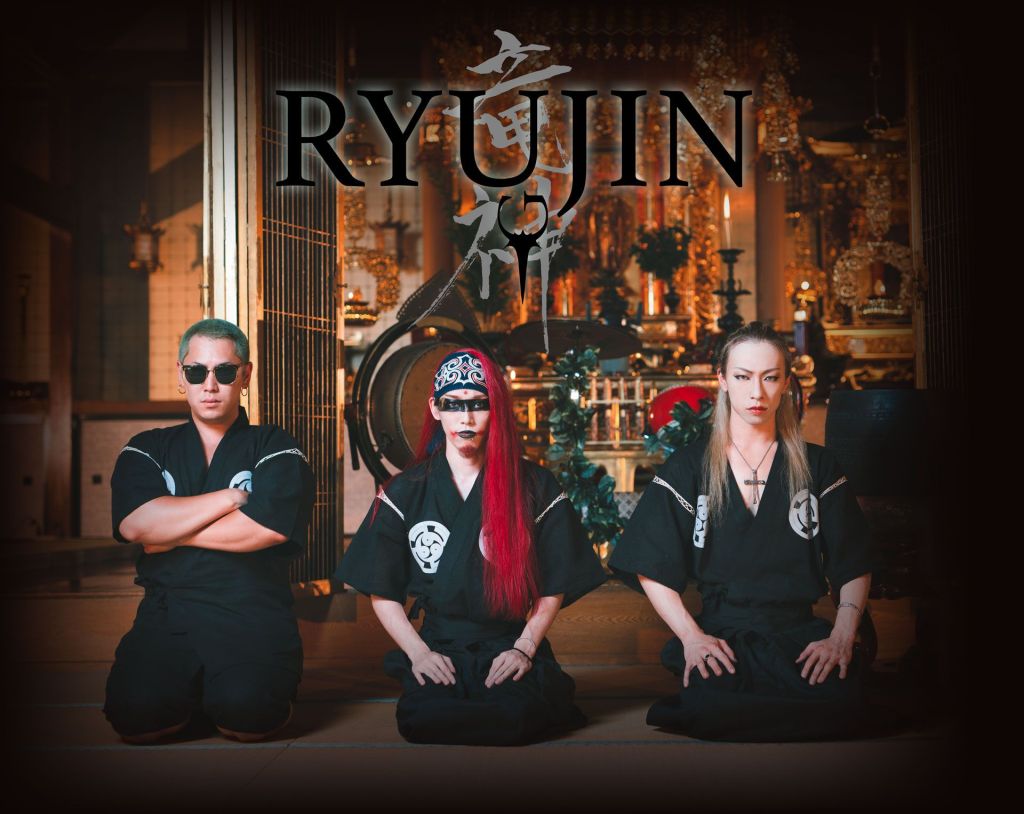
Taking a rest in the temple – photo by Napalm Records
Japan has something that is called Living National Treasure – a program of support for people whose skills, crafts and knowledge help to maintain traditional arts from the danger of being forgotten or lost. While the program itself is very small, public perception of those who cultivate cultural heritage is very high. Those people are called “cultural ambassadors” and often treasured and enjoy a high esteem in the community. Oh, you think a metal band from Hokkaido can’t possibly be considered cultural ambassadors for their country? Tough luck, because the main shredder of Megadeth, Marty Friedman who lived in Japan for the last twenty years was just promoted to that position by the Japanese Government.
In the light of the above, I hope you won’t have anything against me referring to the members of Ryūjin as cultural ambassadors for Japan. They are really good at representing their home country!
The band`s name Ryūjin is a reference to Dragon God, a deity of the sea and protector of Japan, also a play on Shinomoto Ryoji`s name which means “dragon master”. In their video to “Rainbow Song” the band appears in traditional Ainu costumes, a homage to the native population of Hokkaido. Their composition “Raijin and Fujin” tells the story of two mischievous elder Shinto gods, one commanding the thunder and the other being in charge of the wind. The band doesn’t shy from darker episodes from Japanese history. “Gekokujō” refers to military coups (the term meaning lower classes overthrowing the ruling elite) such as Ni-Ni Riku Jiken that happened in the early part of the Showa era (1920s-1930s), while the accompanying video shows the process of nailing a straw doll (wara ningyo) to a sacred tree (shinboku) at a Shinto shrine. The doll ritual dates back to the Edo period and is known as ushi no toki mairi (late night temple visit). It represents placing a deadly curse on a chosen target. It may be an ancient custom but it still happens in Japan, as recently as two years ago. Ryūjin also have a wonderful sense of humour and do not take themselves too seriously. Perfect example of it is “Ninja Dance” that shows the band engaged in a dance competition with the ninja at a location that looks like a Takeshi`s Castle.
“Saigo no Hoshi” is the ninth song on Ryūjin`s debut (or fifth if you prefer) album. Shinomoto Ryoji calls it the band’s first ballad. It does indeed stand apart from the rest of the repertoire. It is heavily inspired by classical music and includes a guest appearance by Mukai Wataru, solo cellist of Kansai Philharmonic Orchestra. Ryoji not only played almost every instrument on the track, but also was responsible for its orchestration and conducting other musicians.
In the singer`s own words he was inspired by Tchaikovsky, Beethoven and Japanese composers like Joe Hisaishi or Akira Ifukushi (you may know him as a composer for Godzilla movies) when writing “Saigo no Hoshi”. The song retains a very dramatic, almost operatic feel – telling a story of a mortally wounded warrior who longs for his family and prays for peace.
Again, nothing that Ryūjin does is by half measures. The details are so perfectly laid out that you must listen to the song and watch the video several times before catching some of the references. Like many things in Japanese, double or even triple meanings are the order of the day.
The title itself is a good example. One word may have multiple translations, depending on the kanji sign used. “Hoshi” is a star, a shooting star to be exact, the one that you make a wish upon if you see it in the night sky, a meteor. “Saigo” translates as “the last”. So, “The Last Star”. It is easy to imagine a weary samurai who sees a shooting star and makes a wish to see his family again. But hoshi may also indicate “want”, in the sense that a person wants or needs something, often badly. The last need of a dying warrior is for peace, so future generations, in the new era will not know war or death.
I am using the words “new era” on purpose. Every time a new emperor takes to the throne in Japan, a new era (reign) begins. 2024 is currently the sixth year of the Reiwa era. The moment I saw the video to “Saigo no Hoshi” I had a very specific event in my head: the battle of Toba – Fushimi, during the Boshin War. It was a clash between forces of the emperor Meiji and the Tokugawa shogunate. The bakufu wanted to preserve shogun`s rule and keep Japan closed to the world. The emperor sought not only to take the political and military power from the shogunate, he wanted to reinvent the whole country on an unspeakable scale. It was not just a war for control, it was a fight of new order versus the old one. You may know the battle of Toba Fushimi from Rurouni Kenshin manga or the movies. You may recall Kenshin`s words of a new era when he hears of the emperor`s victory at the battlefield. The new era that came with Meiji Restoration ended feudal order in Japan, it brought the end of samurai, confiscation of their swords and livelihood. The battle of Toba Fushimi was so fierce and bloody that they are still finding bones of those who perished in it to this day. The emperor`s forces were led by a man known as Saigo Takamori, a samurai and a noble who is regarded as one of the heroes of modern Japan. Coming back to the meaning behind the title of the single. Is it really “The Last Star” or maybe saigo here is a poetic reference to a loyal samurai who would not hesitate to wage a war on his own countrymen in the name of the emperor?

On the set of Saigo no Hoshi – photo by Litchi
Obviously, you may have a different interpretation of the story behind “Saigo no Hoshi”, but to me the samurai of the song is one of those who fought the Boshin War, his dying wish is not just for peace, but for warfare to die alongside with him, the last of the proud warriors.
In the video to “Saigo no Hoshi”, Shinomoto Ryoji plays the main role. His white kimono is stained with blood, his katana is ragged and smeared as well, he can barely walk from his wounds. He makes it to the shinto shrine and perishes leaning against a tree, still holding his sword.
This is an opera, or maybe one-person noh play, full of symbolism that may be hard to understand for somebody who is not familiar with Japanese culture. The white kimono is a sign of death, this is how people are dressed for funerals, including their clothes being worn right over left side. The white chrysanthemums appearing in the video indicate mourning but also being truthful in one`s aims. Like sakura petals symbolizing the transience of life, white chrysanthemum is a very striking example of so-called hanakotoba, the language of the flowers. If you look closely at the handle of the sword that Ryoji is holding, you will see the hand guard (tsuba) has the shape of a camellia flower. Red camellia represents the samurai perishing with grace. Unlike cherry blossoms, camellia doesn’t drop petals. It falls as one piece, strongly and suddenly, just like a samurai`s body should drop when in the act of seppuku. That’s the bushido for you. Do you wonder why samurai would have camellia on their swords? It was their soul, symbol of their status, often the only precious item they owned and how they earned their living for themselves and their families. Swords passed from person to person were often deified and treated as sacred objects, not unlike kami themselves.
I absolutely love the scene when Ryoji passes several tori gates on the way to the shrine, indicating the transition from life into death and then standing among the trees, his clothes restored. Maybe the last wish of the warrior was granted and he became kodama, a forest spirit, protector of nature and a guarantor of peace. Who knows?
There is no better person to sing with Ryoji on “Saigo no Hoshi” than Matt K. Heafy, leader of Trivium. Matt is himself half Japanese and hearing him sing in the language that he practices infrequently is quite a moment. As I said Ryūjin do a good job at being cultural ambassadors of Japan and their music is truly a place where people can find common ground. I also hope that this article will show people that metal bands are not just long haired screamos with little interest in the world, but artists with a vision and something to say.
2024 is the Year of the Dragon. It surely will be the year of the Ryūjin as well.
And I like that this review goes on Indieterria on Valentine`s Day. There is nothing we love more than writing about music that we are fans of!
You can follow the band online:
https://www.facebook.com/ryujinbandjp
https://www.instagram.com/ryujin_band/
https://www.youtube.com/@RYUJIN_BAND
https://www.tiktok.com/@ryujin.band.offic
https://twitter.com/ryujin_band
https://open.spotify.com/artist/3SUKO4vAKUtulR6t99R1Zk
Additional reading:
https://newnoisemagazine.com/interviews/interview-ryoji-shinomoto-of-ryujin-talks-self-titled-debut-album
https://www.guitarworld.com/features/ryoji-shinomoto-ryujin
https://metalinsider.net/interviews/interview-ryujins-ryoji-shinomoto-on-new-album-band-name-change-collaboration-w-matthew-kiichi-heafy
Malicia Dabrowicz
 Indieterria